
How to Get Internet in Morocco: 4 Options Compared
There are four ways to get internet in Morocco: roam on your home plan, install a travel eSIM before you fly, buy a Moroccan prepaid SIM card once you land, or rely on wi-fi. None of them wins outright: it comes down to how long you stay and how much data you actually burn.
Prices checked on 30 August 2026 across seven eSIM providers, local rates from Maroc Telecom, Orange Maroc and inwi, the real cost of out-of-bundle roaming, 4G and 5G coverage in the cities, the Atlas and the desert, phone compatibility, QR code installation, the passport rule for local SIM cards, how much data to budget for your usage, and public wi-fi security: every option goes through the same filter, with figures verified the same day, so you can see which one is cheapest for your own trip.
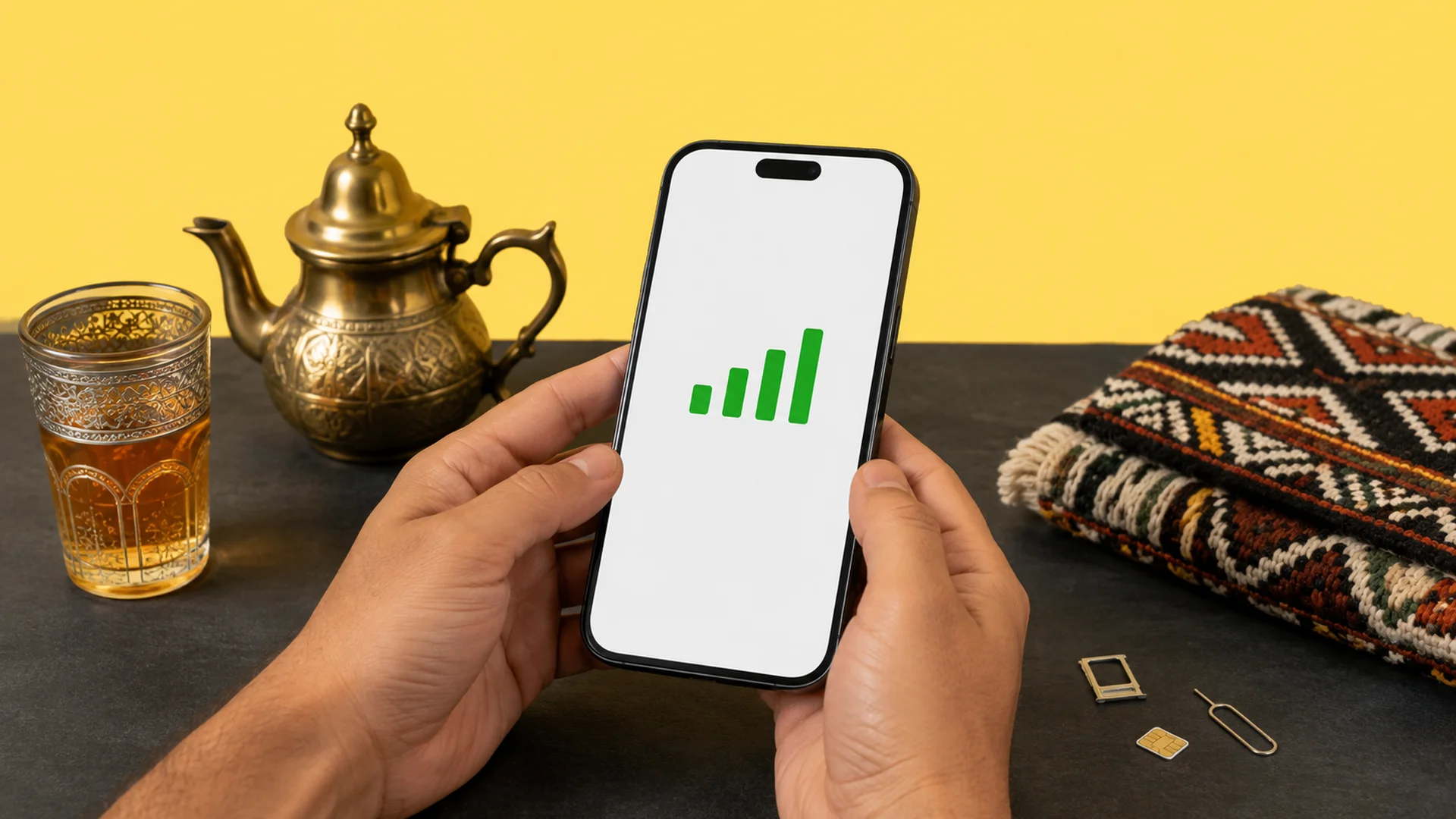
The 4 ways to get internet in Morocco
There are exactly four ways to connect your phone in Morocco, and they split on three criteria: price, setup time and effort once you are there.
1. Roaming on your home plan. Zero setup, but Morocco is not part of the European roaming zone: data is charged on top, except on a handful of premium plans that include the destination.
2. A travel eSIM. You buy a data plan online, install it before you leave, and land connected. It is the only option that asks nothing of you on arrival.
3. A local SIM card. Bought at the airport or in a store from Maroc Telecom, Orange Maroc or inwi. Cheapest per gigabyte, at the cost of a shop visit with your passport.
4. Wi-fi. Free in riads, hotels and cafés, but it does not follow you into a taxi, through the medina, or on the road to Merzouga.
In practice the real question is not which option is best, but at how many days and how many gigabytes each one starts to pay off. That is what the next sections put numbers on.
Option 1: roaming on your home plan in Morocco
Morocco belongs to neither the European Union nor the European Economic Area. Surcharge-free European roaming does not apply: your carrier bills Moroccan data separately, or bundles it only into its most expensive plans.
The clearest example comes from French carrier Free. Its 5G+ plan covers 35 GB of data across 117 destinations, and Morocco is not one of them. Beyond that, Moroccan data costs 3.00 € per megabyte, so a single gigabyte used by accident would run to roughly 3,000 €. The Free Max plan, at 29.99 € per month, does include Morocco with unlimited data. We break it down plan by plan in our Free Mobile country list.
Other European carriers follow the same logic: Morocco falls into a non-EU zone, covered either by a travel add-on bought before departure or by a daily or weekly pass. Orange, for instance, sells a travel pass in 7, 15 and 31-day formats that you can activate on a chosen date. Check the exact price in your carrier's app: these grids change several times a year.
The real trap is not the price of the pass, it is data roaming left switched on with no add-on. Your phone joins the Moroccan network the moment you land, apps sync in the background, and the bill shows up a month later.
The rat's advice: switch data roaming off in the plane, before you land. Turn it back on once your add-on is active or your eSIM is installed. It takes ten seconds and removes the only genuinely nasty surprise of the trip.
Option 2: the travel eSIM, fastest to set up
An eSIM is a digital SIM card: you buy a data plan online, scan a QR code, and the profile installs alongside your home line, which you keep active for banking texts. No store to find, no plastic to swap.
Here are the prices recorded on 30 August 2026 across provider catalogues, on a strictly identical package, 10 GB valid for 30 days in Morocco:
voilà: 16.10 €, or 1.61 € per GB. yesim: 18.00 €, or 1.80 € per GB. Ubigi: 23.00 €, or 2.30 € per GB. eSIMcard: 27.00 €, or 2.70 € per GB. Airalo: 30.50 €, or 3.05 € per GB. Saily: 39.99 €, or 4.00 € per GB.
On that exact package the gap between first and last is more than two and a half times, for the same data on the same Moroccan network. On a smaller 5 GB, 30-day plan the ranking barely moves: 9.30 € with voilà, 10.00 € with yesim, 14.78 € with eSIMcard, 19.50 € with Airalo, 24.99 € with Saily.
It flips as soon as volume goes up. On 20 GB for 30 days, yesim takes the lead at 27.00 €, against 28.50 € for voilà and 38.50 € for Airalo. And on pure cost per gigabyte, eSIMzon comes out ahead with a 14 GB, 30-day plan at 17.20 €, or 1.23 € per GB, a package size the others do not offer.
Each provider has its own angle. Airalo carries the largest destination catalogue. Saily bundles a VPN into its app. Ubigi and yesim push unlimited data plans, from 25.00 € for 7 days with Ubigi. voilà, a French provider riding the Orange Maroc network, plays on value for money (1.61 € per GB in the reading above), with an eSIM that is simple to install, an app that is easy to use for tracking your usage, and human customer support available 24/7.
To compare all 53 eSIM plans available for the destination, size by size and duration by duration, the Morocco eSIM page keeps the full grid updated automatically.
Prices recorded on 30 August 2026 from provider catalogues, converted to euros at the rate each merchant displays. A plan billed in dollars may carry conversion fees from your bank.
Option 3: buying a Moroccan SIM card
Three carriers share the Moroccan market: Maroc Telecom (IAM), Orange Maroc and inwi. All three sell prepaid cards to travellers, and this is by far the cheapest option per gigabyte.
The figures recorded on 30 August 2026 on official sites: inwi advertises a plan at 49 MAD per month for 20 GB, about 4.55 € at the Bank Al-Maghrib reference rate (1 € = 10.7727 MAD on 28 August 2026). Orange Maroc sells a visitor-focused Marhaba offer, as a SIM or an eSIM, with unlimited internet from 120 MAD (about 11.14 €) and tiers at 220 and 320 MAD. An Orange prepaid line ships with 20 MAD of credit included.
Compare that with the previous section: 20 GB costs around 4.55 € locally against 27.00 € on a travel eSIM. The gap is what justifies a shop visit as soon as your stay runs past three or four weeks.
There is a catch, and it is administrative. Under an ANRT ruling, no prepaid SIM can be activated in Morocco without full identification of the buyer: name, surname and ID number, meaning a passport for a foreign visitor. The rule was designed to end anonymous pre-activated cards and has been enforced since 2014. Bring the original passport: a photocopy is usually refused.
Where to buy: all three carriers run desks at Casablanca, Marrakech, Agadir and Fez airports, staffed around arrival times. In town, their official stores and the téléboutiques sell the same offers, sometimes cheaper than at the airport. Your phone must be unlocked to accept a foreign SIM, which is the case for any handset bought outright.
One last thing to plan for: a local line gives you a Moroccan number. Your contacts will keep calling your home number, which stays reachable as long as you leave your main line active in dual SIM mode.
Option 4: public wi-fi and pocket wi-fi
Wi-fi covers fixed locations well in Morocco: riads, hotels, cafés, restaurants and malls nearly all offer it. Excellent as a complement, very poor as your only plan.
The reason is simple: wi-fi does not follow you. Not in the shared taxi to the station, not in the alleys of the Fez medina when your GPS drops, not on the road from Ouarzazate to Merzouga. Those are exactly the moments you need network coverage.
Public wi-fi also raises a security question: on an open shared network, avoid banking and payments, or route them through a VPN. That habit applies everywhere, not only in Morocco.
Pocket wi-fi, the small 4G box that rebroadcasts a network to several devices, can be rented locally by the day. It makes sense from two or three people sharing one plan, or if you need a laptop online as well as a phone. The downsides are known: a battery to charge every night, a deposit to leave, a box to collect and return. Tethering from your phone often does the same job with no extra hardware, if your plan allows it.
How much data to budget for a trip to Morocco
A traveller sticking to GPS, messaging and a little social media burns about 0.16 GB per day, or 1.6 GB over ten days. A classic usage pattern, with music streaming, browsing and heavier social media, sits around 0.46 GB per day, or 4.6 GB over ten days. Someone doing two hours of video calls a day climbs to 2.2 GB daily, more than 20 GB over the same trip.
Those estimates rely on industry averages: roughly 10 MB per hour of GPS, 150 MB per hour of social media, 1 GB per hour of Full HD video and 4 MB per hour of messaging. Our mobile data usage calculator runs the numbers on your real usage and your exact trip length.
In practice, for a one-week to ten-day holiday, a 5 GB plan covers the vast majority of travellers, and 10 GB leaves comfortable room for sharing photos and watching a few videos. Unlimited plans only pay off if you intend to stream seriously or work over video.
The rat's advice: before paying for unlimited, download your Google Maps areas offline and your playlists over wi-fi the night before you fly. Those two moves remove the two biggest data drains of a trip, and a 5 GB plan then lasts without effort.
Network coverage and 5G in Morocco
Moroccan mobile coverage is good in cities and along major roads, patchier in the High Atlas and the southern desert, where 4G can fall back to 3G or vanish between two valleys.
The country went 5G on 7 November 2025, with all three carriers launching commercially at once after the ANRT awarded licences in summer 2025. Their obligations require covering at least 45 % of the population by the end of 2026, then 85 % by 2030, the year of the World Cup Morocco co-hosts. In practice, in 2026 you get 5G in the major metros and their airports, and 4G everywhere else.
One thing to watch on internet calling: voice calls over WhatsApp, Skype and Messenger were blocked in Morocco in January 2016, then restored in November of the same year. They work today, with quality that varies depending on how the local carrier handles that traffic. Keep a plan B if an important call depends on it.
Whether you go eSIM or local SIM, you end up on one of the same three national networks: eSIM providers are resellers riding Maroc Telecom, Orange Maroc or inwi. Reception therefore depends on the host network, not on the brand in your app. Host networks are listed provider by provider on our eSIM provider comparison.
Which option fits your travel profile
There is no single winner, only thresholds. Here is how the four options split by trip length and usage.
A weekend or a 3 to 5-day trip: a small eSIM plan. Budget 2.20 € for 1 GB valid 7 days with voilà, or 5.99 € with Saily over the same window. Nothing to do on arrival, the question is settled before takeoff.
One to two weeks: the most common case, and a 5 to 10 GB eSIM stays the best compromise, between 9.30 € and 16.10 € depending on size and provider. A local SIM would cost a little less, but the gap does not justify a store visit with your passport.
A month or more, relocation, long assignment: the local SIM card becomes obvious. At 49 MAD for 20 GB with inwi, roughly 4.55 €, no travel eSIM keeps up over time. You also get a Moroccan number, handy for bookings and taxis.
Travelling as a group or family, road trip: one data line with a generous plan, shared via tethering, costs less than four individual plans. A rented pocket wi-fi does the same job if you would rather not drain the phone acting as your GPS.
Remote work and video calls: aim for 25 GB minimum, or an unlimited plan. Ubigi lists 25.00 € for 7 unlimited days, Airalo 31.00 € over the same period. Check the fair use policy before buying: unlimited is almost always throttled past a daily threshold.
Frequently asked questions
Does my home plan work in Morocco?
What is the cheapest way to get internet in Morocco?
Do you need a passport to buy a SIM card in Morocco?
Does an eSIM work everywhere in Morocco?
How many GB do you need for a week in Morocco?
Is there 5G in Morocco in 2026?
Do WhatsApp calls work in Morocco?
Most read
 August 18, 202614 min read
Free Mobile country list: the destinations included abroad (2026)
Free 5G+ plan: 35 GB across 117 destinations. Free Max: unlimited in over 140. The full list of included countries, the limits and the plan B.
 Rony
Rony July 28, 20267 min read
Squeezie eSIM: should you use the Saily promo code?
Squeezie sponsors the Saily eSIM with a -15% promo code. We break down the offer, compare price per GB and tell you whether it is really the best deal.
Rony August 28, 202610 min read
Free eSIM: what is actually free, and what is not (2026)
Six eSIMs with real free data, as reported on September 15, 2026, from providers, their terms and conditions, and when paying €0.80 becomes the smarter choice.
Rony August 19, 20269 min read
La Poste Mobile eSIM: not available yet, and here is when that changes (2026)
La Poste Mobile does not offer eSIM yet, only physical SIM cards. Announced launch date, alternatives and compatible phones in 2026.
Rony August 25, 202610 min read
Numero eSIM review: legit or not? What the ratings don't tell you (2026)
Suspended Trustpilot rating, 3.5/5 on the App Store, disputed charges: our full Numero eSIM review, with verified prices and the alternatives.
Rony August 26, 20269 min read
Does WhatsApp use mobile data? How much, and how to stay in control (2026)
WhatsApp eats into your data plan: from 0.01 MB per message to 20 MB per minute of video call. The numbers, the settings that save your plan, the travel case.
Rony